Logical Fallacies Exposed

Logical fallacies are examples of fallacious, or faulty, arguments. At best, they represent flawed reasoning—making claims that are not supported by reasons or warrants, or drawing conclusions that don’t match up to the information you have. At worst, they can be deliberate attempts to mislead or confuse someone, to persuade through providing misinformation, usually to serve some hidden agenda. Many of the logical fallacies we will examine are common mistakes we all make, but some of them are established propaganda techniques.

e155ccb72f2ed7524f14c77095f344a7c9d419409867e144fe15a0f844ecec83

Continue reading

Best Life Hack | Logical Reasoning

Reasoning, in its most fundamental sense, is the process by which we take bits of information and knowledge that we already have, and compare or combine them to generate new knowledge. It describes our ability to move from what we know to what we don’t know.

We do this by drawing conclusions from a set of premises – things we already know (or believe) to be true. The way we combine the premises to produce a conclusion is called an argument. The goal is to construct a sound argument so that we draw conclusions in such a way that they are guaranteed – or at least very likely – to be true. We want to come to the right conclusions, but this can be tricky.

Continue reading

Go figure…

Astound your teachers by becoming a metaphor master! Impress your friends with your command of the literal and figurative! In this lesson you’ll get the quick and dirty, just-the-facts-ma’am introduction to what figurative language is, and how and when to use it. You’ll meet metaphors and similes, find examples in everything from sonnets to Selena Gomez, and then create a few original ones yourself. Once you know these concepts inside and out, learn to recognize them, and even come up with your own, you’ll boost your reading comprehension, your vocabulary, AND your writing skills.
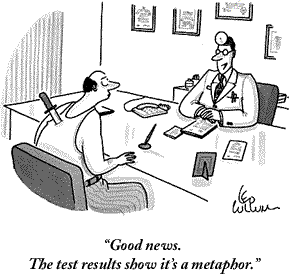
metaphor

If you’ve ever read a book, listened to the radio, or had basically any kind of human interaction, then you’ve already had a lot of experience with figurative language.

If you were raised by wolves in the forgotten wilds of Ontario, you’ve never heard anything like it–get ready to have your mind blown.

You see, figurative language is so common that most of us use it all the time without even realizing. Assuming you’ve spent your life communicating with people and not howling at the moon, you probably have a whole store of figures of speech in your vocabulary.

Continue reading